
Expert Tree Cutting & Trimming Services in Alderwood, WA
Transforming Your Trees Through Proper Trimming with Arborist Services
Tree trimming is both an art and a science; it requires an extensive knowledge base of tree biology, tree growth patterns, and tree structural dynamics. Our team at Alderwood Manor Tree Care has professionally trained arborists who will ensure that your trees are trimmed and cut correctly by providing expert tree cutting and trimming services to improve your trees’ overall health, safety, and aesthetics, while also encouraging healthy growth into the future.
Pruning your trees regularly is one of the best ways to invest in your landscape. A well-kept tree resists storm damage better, suffers from fewer pests/diseases, lives longer, and increases the value of your property as well as your curb appeal. However, poor pruning practices can cause irreversible harm to the health and structure of your trees. This is why hiring a professional to prune your trees is important; our certified arborists know exactly what areas, when, and how to cut each tree to achieve the maximum results possible.
Our experienced crew provides high-quality service to meet all of your tree trimming needs, whether you require routine maintenance pruning, corrective pruning on overgrown trees, removal of storm-damaged limbs, or specialized pruning techniques such as vista pruning or fruit tree care. We have the experience to meet all of your needs and exceed your expectations. We do not simply trim your trees; we carefully train and shape them to grow naturally while also meeting your specific landscaping needs.
Our Tree Trimming Services
Comprehensive Pruning Solutions
Our services include all types of pruning, designed for each tree’s unique requirements and your landscape objectives.
Crown Cleaning: Crown cleaning is our foundational pruning service. It involves removing dead, dying, diseased, or damaged branches from a tree’s entire canopy. This maintenance pruning will improve the tree’s health, decrease its potential as a hazard, and also improve its appearance. Crown cleaning is recommended by us at intervals of three to five years for most mature trees as a maintenance measure.
Crown Thinning: Crown thinning is a selective process of cutting branches from a tree’s canopy to reduce its density while keeping its natural shape intact. Thinning increases light penetration and air circulation, and it decreases the amount of wind resistance that a large tree has. Additionally, this method helps decrease the weight on the heavier branches of a tree, especially those species such as maple that have dense crowns. Thinning allows for better growth of plants beneath trees due to increased sunlight and air circulation.
Crown Raising: Raising a tree’s crown means removing lower branches to provide for pedestrian, vehicle, building, and line-of-sight clearances. Raising a crown provides views, gives access for lawn mowers underneath trees, and creates a usable area underneath the canopy of the tree. We raise crowns slowly over time on younger trees to prevent lifting the tree too much and keep the proper live crown ratio.
Crown Reduction: Reducing a tree’s crown (the area where the leaves grow) decreases the total height and spread of the tree, using proper methods that maintain the tree’s natural form. Topping, which is damaging to trees, is different from reducing, since we make cuts to lateral branches that can take on terminal functions. Due to the technical difficulty involved in making these cuts, this type of prune should be performed by an experienced arborist.
Structural Pruning: Structural pruning involves selecting and developing the main leader of a young tree, eliminating competing leaders, removing branches that may break off easily, and spacing lateral branches to create a well-developed branch system. Structural pruning is investing in the health of your young tree and will help to minimize costly corrective work or removals as the tree matures.
Removing Deadwood: Dead branches in a tree’s canopy create falling hazards and allow decay organisms to enter the tree. Removing deadwood systematically improves both the safety and the health of the tree. We recommend periodically removing deadwood as a maintenance activity between more substantial pruning cycles for larger mature trees.
Get A Free Quote
Pruning Techniques and Practices for Tree Health
Using Science in How We Cut Trees
Arborist professionals have developed tree care practices based upon science, with an emphasis on creating long-term tree health and sustainability. The cutting techniques used by professional arborists reflect today’s scientifically-based understanding of how trees grow and respond to wounds.
Correct Techniques for Making Cuts on Trees
The Three-Cut Method of Pruning Branches Larger Than 1 to 2 Inches in Diameter: For making cuts on branches larger than 1 to 2 inches in diameter, a professional arborist uses a “three-cut” method. Using this method prevents the bark from being torn and allows for clean cuts to be made. These clean cuts allow for a successful compartmentalization of the wound by the tree through its vascular system.
Preservation of the Branch Collar: Trees compartmentalize wounds best when the cuts made are at or near the branch collar, which is the swollen area where a branch attaches to a main stem (trunk) or another branch. As such, all cuts made during pruning should locate and protect the branch collar. Flush cuts can damage the trunk tissue of the tree.
Thinning vs. Heading Cuts: Thinning cuts remove an entire branch back to its point of origin to maintain the natural shape of the tree. Heading cuts reduce the length of a branch to either a lateral branch or bud, causing a stimulation of new, dense growth. Mature trees will receive primarily thinning cuts, while heading cuts are typically reserved for certain structural pruning applications.
Advanced Target Pruning: Dr. Alex Shigo’s research has shown that target pruning involves locating cuts exactly where a tree can defend a wound most effectively. Advanced techniques require knowledge of tree anatomy and the ability to recognize small but important structural features that indicate optimal cut locations.
Maintaining Natural Shape: We prune to develop or enhance the natural shape of a tree. Understanding species-specific growth habits guides our work. Attempting to create unnatural shapes in a tree creates long-term maintenance issues and compromises the health of the tree.
Management of Wound Closure: Larger wounds take longer to close and offer more opportunities for decay to develop. To minimize the development of decay, we limit the removal of branches larger than 4-inch diameter to only those cases required to address a safety concern or to otherwise improve tree health. If a larger cut cannot be avoided, we make additional cuts during subsequent years to allow for adequate closure time.
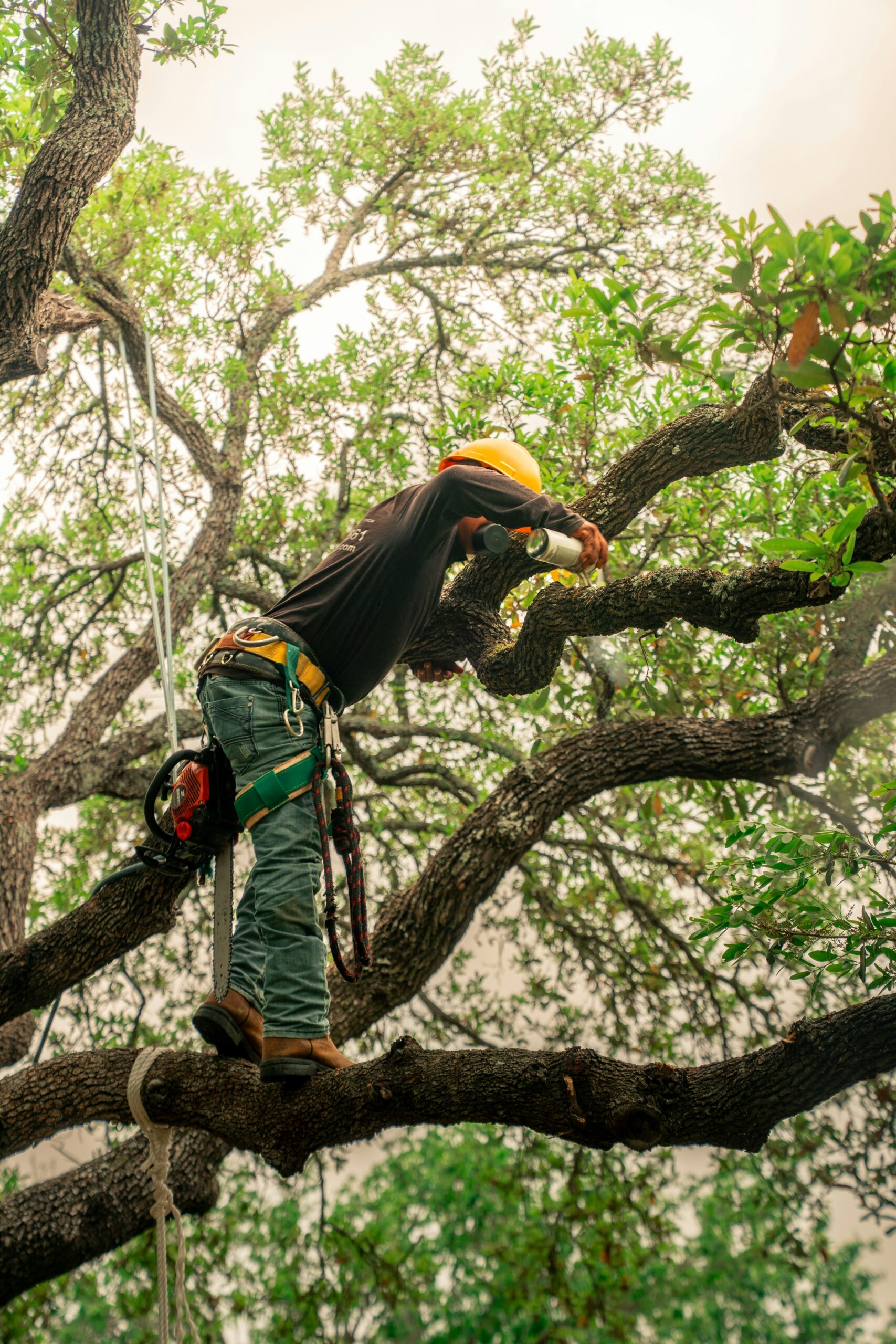
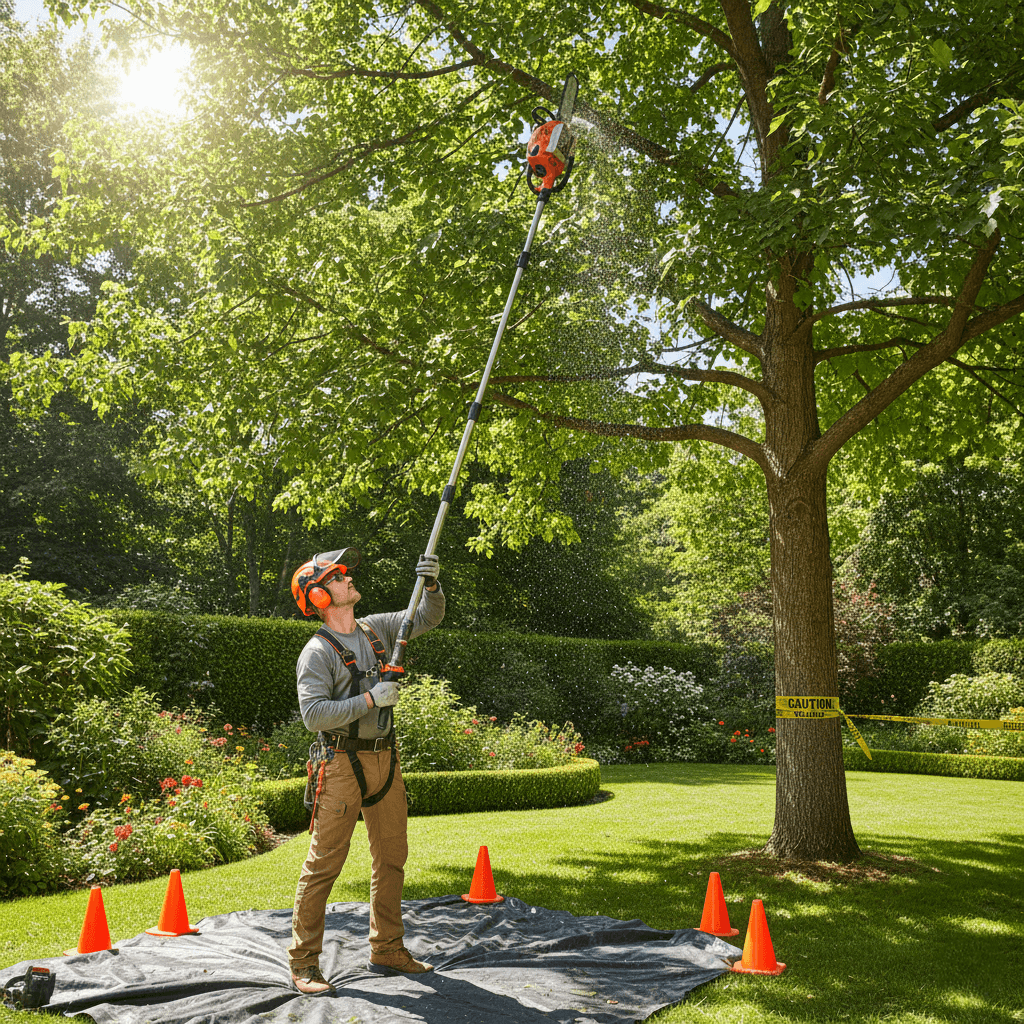
Pruning for Safety
Reducing Hazards & Risks
Safety is always a top priority in all of our pruning recommendations and in how we prune.
Identifying Hazardous Branches: Dead branches, particularly dead branches that are large, have the potential to fall at some point and pose a serious hazard. Also, dead branches with decay, cracks, or weak attachment points have the potential to fail. Another type of hazardous condition is when co-dominant stems grow together and develop “included bark,” which creates structural weakness. Our certified arborists will be able to identify these conditions and recommend an appropriate solution.
Preventing Storm Damage Through Pruning: By proactively pruning the tree, you can help prevent storm damage by removing the weakest branches, thinning out the dense canopy to reduce wind resistance, and also balancing an unbalanced crown (uneven) to create a balanced crown. If you live in a location that has a lot of exposure to the elements (wind), or if there are high-value items located under the tree (such as a house, garage, etc.), then it would greatly benefit from preventive pruning.
Utility Line Clearance: When trees grow towards power lines, they can create a serious hazard. The purpose of utility line clearance is to prune the tree so that it maintains the required distance from the power line(s). Using directional pruning techniques, we can slow down the growth of the tree back towards the power lines. In cases where the lines serve your property, we will work with the utility company to ensure coordination when necessary.
Structure Clearance: When branches of a tree touch a roof, it can create damage to shingles and gutters and allow pests to enter the structure. Also, branches hanging over a structure can drop leaves and debris onto the roof and/or walls of the structure. We can create and maintain the proper clearances between the tree and your structure to protect both the tree and the structure.
Walkway/Driveway Clearance: When branches of a tree hang over walkways and/or driveways, they create a head clearance hazard and obstruct vehicle movement. Crown raising allows us to safely raise the crown of the tree to provide ample clearance for both pedestrians and vehicles.